
SMART Sub-Project Overview
Promotion of Value-added Vegetables & Instituting RECP Practices
Organization’s Information (Up to 03 December 2024)
CE: Aminul IslamTotal Staffs (Permanent)
612
Capital Fund
৳ 67.97 C
Total ME Loan
৳ 111.80 C
Total Loan Outstanding
৳ 329.80 C
Total Outstanding
Total Staffs / Capacity
Capital Fund
Sub-Project Details & Objectives
Title of the Sub-Project:
Promotion of Value-added Vegetables for sustainable growth and instituting RECP practices.
Sub Project Objective:
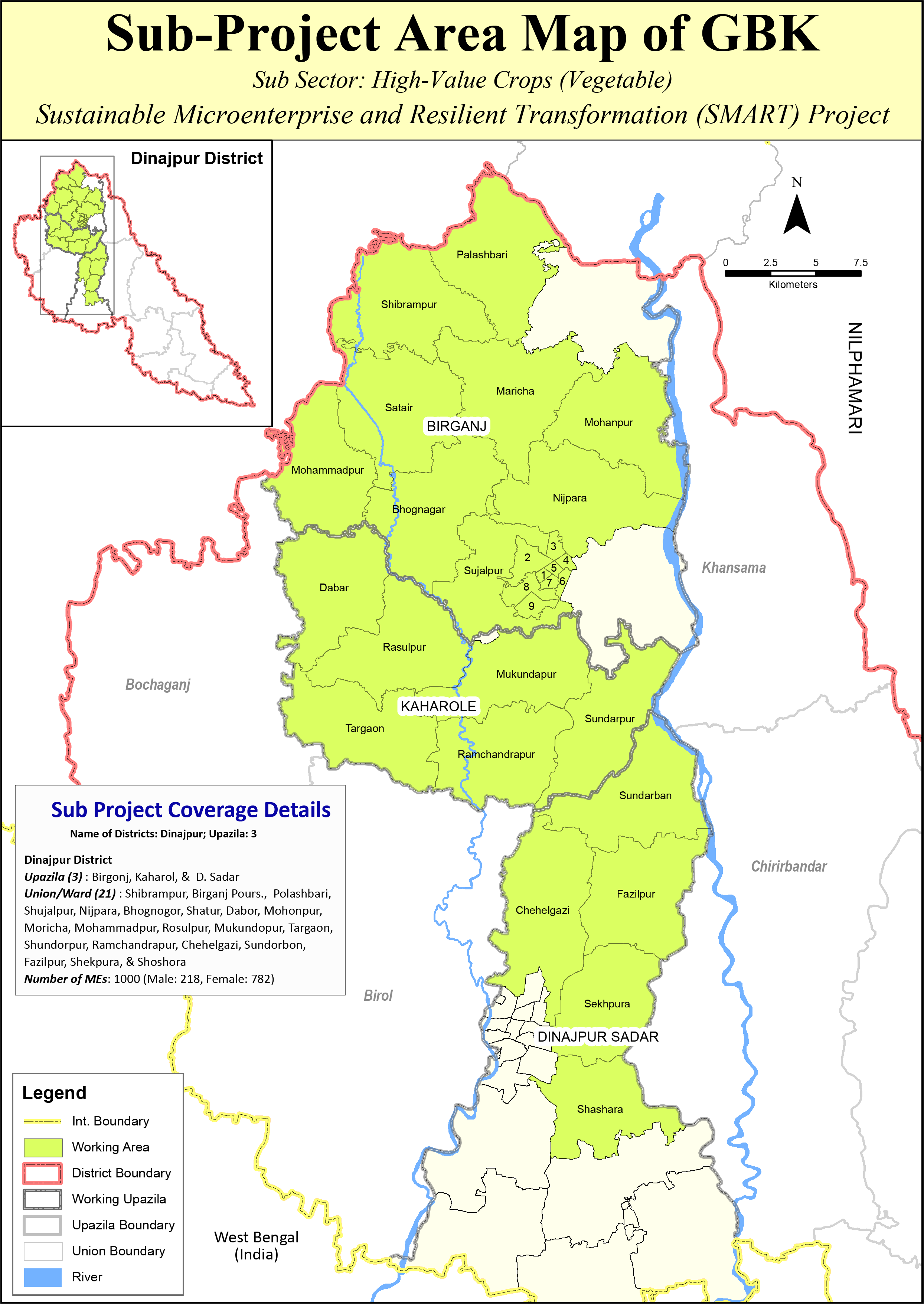
Sub-Project Coverage
Number of Districts
Dinajpur
Number of Upazila
03 (Dinajpur Sadar, Birgonj & Kaharol)
Number of ME
1000
Sub Project Duration
03 December 2024 June 2028
Type of Business, Sector and Sub-sector
Type of Business
(Agribusiness / Manufacturing / Service)Sector
Sub-sector
Rationality of the proposed Sub-project
In the proposed project area, vegetable growers, market actors generally cultivate and market vegetables in
conventional methods, but cultivation in environmentally friendly ways is not expanding as expected. High
value vegetables like beetroot, cherry tomato, summer tomato, bean, lettuce, squash, capsicum, broccoli and
early cauliflower, tomato, brinjal, corolla, cucumber, gourd, chichinga, sweet potato. Due to sufficient
demand of vegetables like ol, kachurlati, sajne/raikhanjan etc. in the national and international markets,
there is a possibility of increasing the interest and acceptance of cultivation of these vegetables at the
producer level.
High value vegetables mentioned above may be included in the implementation of the sub-project. Due to the
lack of technical knowledge, financial capacity and necessary quality agricultural materials in the
cultivation of these vegetables, it is not possible to achieve the desired results of the crop. Marketing is
possible by increasing the quality of vegetables through eco-friendly agricultural practices and modern
agricultural practices. There are opportunities for processing, product branding, packaging, promotion and
market expansion through maximum and optimum utilization of the product.
Experience of PO working in green business
| Project/Activities | Funding Org | Area | Participants | Period |
|---|---|---|---|---|
| Sustainable Enterprise Project (Beef Fattening) | World Bank, PKSF, GBK | Dinajpur | 1500 | Jan 2021 - Jan 2024 |
| Extended community climate change project | GCF, PKSF, GBK | Nilphamari | 2147 | Nov 2020 - Apr 2024 |
| Sustainable Agriculture through Farming... | JICF, Japan | Rajshahi | 300 | Apr 2021 - Mar 2024 |
| Livelihood Enhancement through integrated... | JICF, Japan | Rajshahi | 400 | Apr 2020 - Mar 2024 |
Environmental Classification
Cluster based on ECR (2023), 7(2)
ECCU Information
Value Chain Actors Mapping of the Cluster
Input Suppliers
(Seed, Fertilizer, equipment & Irrigation)Value Chain Constraints & Actions
| Constraints in the Value Chain | Proposed Interventions | Status |
|---|---|---|
| Lack of proper knowledge on climate-resilient RECP (energy, water, soil, air, etc.) practices. | Awareness creation and technology transfer to vegetables farmers on climate-resilient RECP and green practices. | Ongoing |
| Bio-pesticides and organic fertilizer not available to farm house | Input shop development and increase production of organic fertilizer | Initiated |
| Quality seeds & sapling not available | Nursery development | Pending |
| Lack of knowledge on GAP, RECP for efficient crop production. | Awareness development with practical training | Active |
| Vegetables wastage | Proper post-harvest management and conversion of waste to resources | Initiated |
| Low price | Market linkage and Export | Planned |
Identification of Environment & Climate Problems
Climate Vulnerability
DroughtWaste Produced by MEs
- Solid waste:
- Plastic waste: Abandoned polythene bags and bottle of fertilizers and pesticides
- Decomposable organic waste: Leaves, spoiled vegetables, straw, paper made cartoon etc.
Work Environment & OHS
- Use of PPE
- Use of first aid box
Environmental Impacts Due to Business Operations
Proposed RECP Practices to be adopted by MEs
Balanced fertilizer, Organic fertilizer and bio-pesticides, Quality seeds and sapling, Ecological farming.
Installation of drip/sprinkler irrigation, mulching, low pressure nozzle, valve, hosepipe etc.
Solar Panel for Irrigation, Solar light trap.
Utilize the crop residues to produce organic fertilizer etc., Tricho-compost and compost preparation. Detailed as Attached in (Annex-B).
Intervention Targets (MEs)
Activities for Enhancing MEs’ Environmental-Knowledge Capacity
| SL | Issues / Problem | Activities | Sub-activities | Rationality | Implemented By |
|---|---|---|---|---|---|
| 1. | Inadequate knowledge on climate vulnerability and RECP | Training | Training on climate vulnerability (1000 MEs, 40 batch, 25 MEs/batch) | Climate vulnerability awareness will be developed | PO |
| 2. | Lack of knowledge on advanced technologies on good agricultural practices | Training | Training on advanced technologies on good agricultural practices (280 MEs, 12 batch, 25 MEs/batch) | MEs will be acknowledged on new technology | PO |
| 3. | Insufficient information and linkage with other stakeholders | Workshop and seminar | Workshop and seminar (3 workshop and/or seminar) | Stakeholder will be acknowledged on new technology | PO |
| 4. | Limited opportunities to practically learn local and national best practices | Exposure visit | Specific field visit (5 visit) | ME will learn about new technology | PO / ME |
| 5. | Lack of platform for enhancing environmental awareness | Environmental club | Club formation (4 club) | Awareness creation | PO / ME |
Activities for Demonstration of Climate-Resilient RECP & Skills Development
| SL | Issues / Problem | Activities | Sub-activities | Rationality | Implemented By |
|---|---|---|---|---|---|
| 1.2.1 | Inefficient use of water | Introduction of water saving technology (300 MEs) | (a) Installation of Sprinkler irrigation (b) Installation of water saving instruments-nozzle, water meter, valve etc. (c) Installation of moisture meter |
Efficient use of water | ME |
| 1.2.2 | Reduce soil fertility | (a) Ecological farming (100 MEs) (b) Mechanical weeding (100 MEs) |
(a) Demonstration (b) Mechanical weeder introduction |
Increase soil fertility | ME |
| 1.2.3 | Air pollution | (a) Intregated pest management (800 MEs) (b) Organic fertilizer (700 MEs) |
Demonstration | Reduce chemical use | ME |
| 1.2.4 | Unmanaged wastages | Introduction of proper waste management system (150 MEs) | (a) Development of waste collection centre / pit in Market (b) Organic (e.g. trico- compost, vermin-compost) fertilizer production |
Waste management | PO / ME |
| 1.2.5 | Health hazard | Introduction of Occupational Health and Safety (OHS) system (500 MEs) | (a) Use of PPE (b) Use of first aid box |
Improve health condition and health safety | ME |
Activities for Digitalization of Environmental and Financial Management System
| SL | Issues / Problem | Activities | Sub-activities | Rationality | Implemented By |
|---|---|---|---|---|---|
| 1. | Manual loan processing which is time consuming | System up gradation | Software up gradation | To expedite loan process within short period of time | PO |
Activities for Capacity Building of POs
| SL | Issues / Problem | Activities | Sub-activities | Rationality | Implemented By |
|---|---|---|---|---|---|
| 1. | Project Implementation | PIU establishment and sub project implementation | - Staff recruitment and others - Workshop (Inception and closing) |
Project implementation and monitoring | PO |
| 2. | Office equipment and furniture | Office facilities development for PIU | Procurement of office equipment and furniture | Project implementation and monitoring | PO |
| 3. | Project documentation | - Baseline & end line study and Documentary etc. - Sub project audit |
Service procurement | Project implementation and monitoring | PO |
| 4. | Capacity development of the PIU and PO staffs | Staff Skill Development | Training, exchange visit etc. | Project implementation and monitoring | PO |
Activities for Enhancing Common Facilities & Enabling Environmental Systems for ME Clusters
| SL | Issues / Problem | Activities | Sub-activities | Rationality | Implemented By |
|---|---|---|---|---|---|
| 1. | Solar based irrigation system not developed | Introduction of solar irrigation | Infrastructure establishment (1 Unit; 40 MEs) | Solar Irrigation system will be developed | PO / ME |
| 2. | Safe vegetable collection centre not available near the farmers field | Vegetables collection centre development near the farmers field | Infrastructure establishment (2 Unit; 100 MEs) | Collection centre will be developed near the farmers field | PO / ME |
| 3. | Vegetables Post-harvest management facility not available | Vegetables sorting, grading and packaging system development | Establishment of facilities for grading, storing packaging room etc. (1 facilities; 100 MEs) | Improve contemporary fruits postharvest facilities and sustainable revenue generation | PO / ME |
| 4. | Proper sanitation facilities not available at market place | Sanitation facilities development in market place | Construction of hygienic latrine with water facilities (1 facilities; 300 MEs) | Improve market environmental condition | PO / ME |
Activities for Enabling MEs to Develop a Green Value Chain & Expand Markets for Green Products
| SL | Issues / Problem | Activities | Sub-activities | Rationality | Implemented By |
|---|---|---|---|---|---|
| 1. | Less aware about the importance of certification | Aware and Support MEs to get Certification (Business, Product etc.) | - Assist MEs to get certificate - Linkage workshop/meeting with respective certification authority (Training 4 Batch; 100 MEs) |
Formalisation of business | ME |
| 2. | Improper of Value chain system | - Promotion of product | - Ensuring product labelling, packaging and marketing (4 unit) | - Product value Addition - Maintaining product quality in an environmentally friendly manner |
ME |
| 3. | Value added products are not selling higher prices | Fair participation, leaflet, brochure poster development for premium market. | - Material preparation and content development | ME will get higher price | PO & ME |
Activities for Revenue Generating Common Services (Loan)
| SL | Issues / Problem | Name of the common service Activities | How the cluster will be benefited by this activity | Implemented By |
|---|---|---|---|---|
| 1. | Unavailable of climate resilience and drought tolerant quality planting materials | Nursery Development for quality seedling | Climate resilience and drought tolerant quality planting materials will be accessible, affordable to the cluster ME | ME |
| 2. | Lack of organic fertilizer | Organic fertilizer Production (Vermi / Trico compost) | Organic fertilizer will be available at the cluster level with reasonable prices and chemical fertilizer use will be reduced | ME |
| 3. | Organic input like color trap, bio pesticides, light trap not available at the cluster | Environment Friendly Input Supplier Development | Environment friendly agricultural input such as compost fertilizer, bio pesticides, pheromone trap, Yellow trap, bio fertilizer etc will be available for the cluster ME with in guarantee | ME |
| 4. | Lack of Agricultural mechanization | Agricultural Mechanization | Labour cost will be reduced, Energy efficient practices will be adopted | ME |
| 5. | Safe vegetables sale centre not available | Safe vegetables sale centre development | Safe vegetables will be available at market | ME |